Don't Wait Until It's Too Late: How to Save Aging Photos, Slides & Tapes Before They're Gone
"I wish we'd done it sooner."
That's one of the most common things I hear.
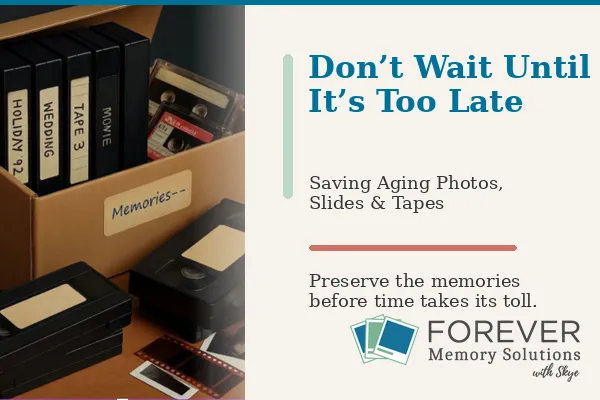
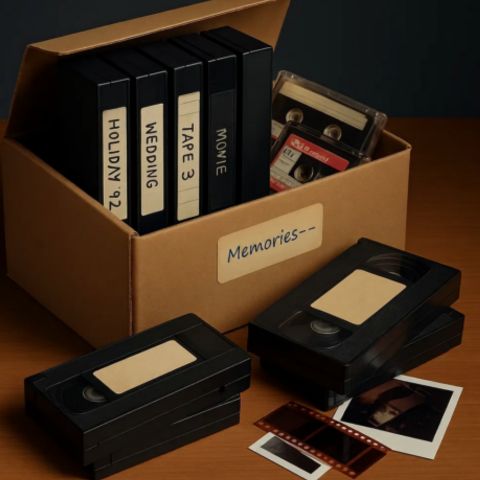
Someone will tell me about a box of slides they found in their parents' garage — slides no one had looked at in thirty years. Or a stack of VHS tapes labeled in their mom's handwriting: Christmas '89, Emily's First Birthday, Grandpa's 80th Party.
And then they tell me: "We finally tried to watch them — and they were just... gone. Fuzzy. Distorted. Some of them barely played at all."
Every single time I hear that, it breaks my heart a little. Not to be dramatic, but those moments on those tapes? They can't be recreated. They can't be bought back.
That's why I write these memos.
Not to scare you, but to gently remind you that the clock on some of these old formats is actually ticking. And the good news? It's probably not too late. But "probably" isn't a comfortable word when it comes to something this precious.
Let's talk about what's actually happening to those old memories and what you can do about it.
What's Happening to Your Old Media Right Now
You don't have to do anything wrong for photos, tapes, and slides to deteriorate. Time does the work all on its own.
📸 Old printed photos begin to fade, yellow, and crack over time — especially if they've been exposed to humidity, heat, or fluctuating temperatures. Those plastic photo album pages from the '70s and '80s? Some of them are actually trapping acids that are eating the photos from behind.
📼 VHS tapes have an average lifespan of roughly 10–25 years. Many of the home movies recorded in the 1980s and 1990s are well past that window. Magnetic tape loses its charge over time, and mold, heat, and humidity accelerate the damage dramatically. Even tapes that "seem fine" may have degraded quality you won't notice until you try to play them.
🎞️ Slides and negatives are often in better shape than photos — but not always. Color slides can experience what's called "color shifting," where the dyes fade unevenly, leaving images that look washed out or strangely tinted. Negatives stored in poor conditions can warp, crack, or develop mold.
📋 Documents, letters, journals, and genealogy materials are vulnerable to everything from moisture and insects to simple fragility from age. Paper becomes brittle. Ink fades. Handwriting disappears.
None of this is your fault. It just happens. But knowing it's happening is the first step to doing something about it.
Where to Start When You're Overwhelmed
If you've ever looked at a box full of old media and felt completely frozen, you're in very good company.
The trick isn't to do everything at once. The trick is to do something.
Here's a simple starting point:
Find your most at-risk items first. VHS tapes and old magnetic media should generally be prioritized because they deteriorate faster than photos.
Don't sort everything before you start. You don't need to organize the whole box before anything gets scanned. Just start.
Pick one "box of meaning." Maybe it's the box from your parents' house. Maybe it's the tapes from when your kids were little. Start there.
Don't let perfect be the enemy of done. Getting things digitized imperfectly is infinitely better than leaving them in a box until it's too late.
You don't have to tackle everything. You just have to start.
What Digitization Actually Looks Like
For a lot of people, the idea of "digitizing" old media feels technical and intimidating. It doesn't have to be.
When you work with a professional digitization company (like FOREVER ), you send your old media such as photos, tapes, slides, negatives, scrapbooks, documents, etc. and it gets professionally converted into high-quality digital files.
Those files can then be:
Stored permanently in a secure, backed-up location
Shared with family members anywhere in the world
Organized using tools like facial recognition to find specific people or moments
Used to create photo books, prints, gifts, or video compilations
The hard part isn't the technology. The hard part is deciding to start.
A Gentle Reminder About Inherited Collections
Many of my clients come to me after a parent passes away, and they've suddenly inherited decades of memories such as boxes of photos, albums, tapes, slides with no context, no labels, no one left to ask.
If your parents or grandparents are still with you, this is a beautiful opportunity to do two things at once: preserve the media and record the stories.
Sit with them. Ask about the photos. Record the answers. Those stories are just as priceless as the images themselves and they're even more fragile!
You Don't Have to Do This Alone
This is exactly the kind of thing I love helping people with. Whether you have one VHS tape or fifteen shoeboxes of slides, we can figure out a plan together.
You don't have to know where to start. That's what I'm here for.
📬 Message me anytime — I'm happy to help you figure out the first step.
Start with one meaningful box. That's enough.
— Skye