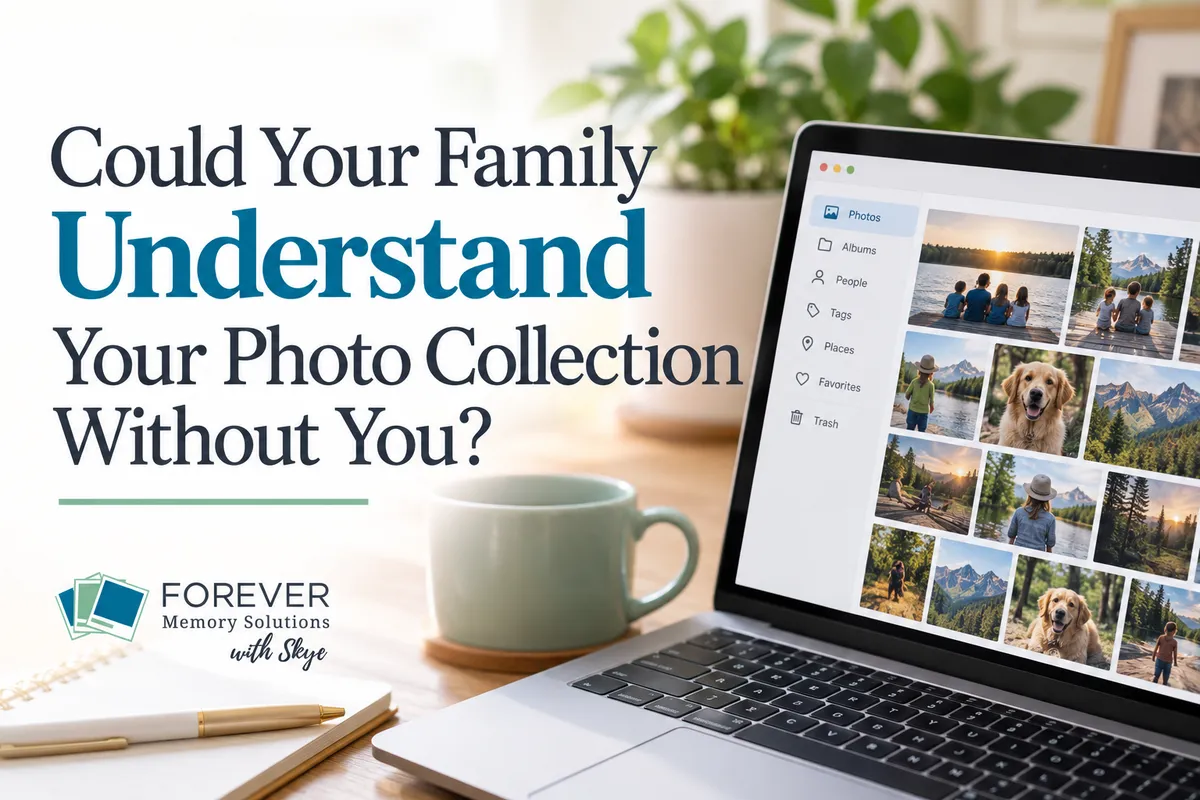
Could Your Family Understand Your Photo Collection Without You?
Imagine handing your entire photo collection to one of your children or grandchildren tomorrow.
You don't get to sit beside them and explain it. You can't say, "Those are Dad's cousins," or "Look in the Alaska album," or "That date isn't right—we know it was sometime in the early 1970s."
They just have the collection.
Would they understand it?
We spend a lot of time thinking about preserving our photos. We back them up, digitize the old ones, organize the digital ones, and hopefully put them somewhere safe.
But preserving a photo collection isn't quite the same thing as leaving behind a usable photo collection.
If you're the only person who understands how everything fits together, some of that organization lives in your head rather than in the collection itself.
Organization Is Part of Preservation
Think about how much information you automatically know when you look at your photos.
You recognize the people. You know which side of the family they belong to. You know that "Grandma's House" means your maternal grandmother's home in Montana, not your husband's grandmother's house in Idaho.
You know why a particular photograph matters even though, to someone else, it might look completely ordinary.
You also know your system.
Maybe you organize by year. Maybe you have albums for each child, family vacations, holidays, genealogy, school years, or major events. Maybe you've created tags for places and topics.
That structure is information, too.
A well-organized photo collection doesn't just help you find things today. It helps someone else understand the collection tomorrow.
What Would Be a Mystery?
Try looking at your photo collection as though you've never seen it before.
Would another person be able to answer questions like these?
Who are the people in these photos?
Approximately when were they taken?
Where were they taken?
Which photos belong to which side or branch of the family?
What do the album names mean?
Are there important photos that appear in more than one album?
Which photos are especially meaningful?
Where would someone look for a particular person, event, or time period?
Is there anything they need to know about the way the collection is organized?
You don't need a perfect answer to every question. And you certainly don't need to write a paragraph about every photograph.
Sometimes a name is enough.
Sometimes it's an approximate date.
Sometimes adding a person, album, tag, location, or short description provides the missing piece of context.
The goal is to leave enough clues that someone besides you can navigate the collection.
Create a "Start Here" Album
Here's an idea I especially like: create a "Start Here" album at the beginning of your collection.
Think of it as an owner's manual for your photos.
It could explain, in simple terms, how you've organized everything and where someone should look first.
For example, your Start Here album might explain:
how your albums are arranged
what your naming system means
how you've identified different family lines
how approximate or unknown dates are handled
what your most important albums are
where genealogy or historical family photos can be found
what tags, keywords, or other organizational tools you've used
anything unusual about your system that might not be obvious to someone else
You could also include a key or index as a PDF that visually shows the structure of your collection.
It doesn't have to be complicated. It might simply show your major categories and what's underneath them:
Family Photos
→ By Year
→ Holidays
→ Vacations
Family History
→ Cranor Family
→ Maternal Line
→ Paternal Line
→ Ancestors
Special Collections
→ Scanned Photos
→ Family Documents
→ Favorite Photos
Your structure will be different, of course. The important thing is that someone can look at the index and understand the big picture.
And What If They Could Hear It From You?
Your Start Here album could include something even more personal: a video message from you.
Not a complete family history. Not the story behind every photograph.
Just you, welcoming the person who someday opens the collection.
You could tell them why you created it, how you organized it, what you hope they'll do with it, and where you think they should begin.
Imagine one of your grandchildren—or great-grandchildren—opening your photo collection decades from now and finding you there to greet them.
"Hi. If you're watching this, you're probably trying to figure out what I've done with all these photos. Let me show you where to start."
What a gift that could be.
Make the Collection Understandable While You Can
This doesn't need to become another enormous photo project.
Start with the information that only you know.
Identify people while you still recognize them.
Add approximate dates when exact dates aren't available.
Give albums names that will make sense to someone besides you.
Add a little context to photographs whose significance isn't obvious.
And create that Start Here album—even if the first version is very simple. You can add to it as your organization evolves.
Technology and organizational systems will change over time. The important thing is to leave enough information and context that the next person isn't starting with a giant collection of unexplained files.
Because the goal isn't simply to leave your family a lot of photos.
It's to leave them a collection they can understand, navigate, and continue to care for.
And if you're thinking, "This sounds wonderful, but first I have to figure out the collection I already have," that's exactly the kind of thing I help people with. I can teach you how to organize your photos, work alongside you as you create a system, or do much of the organizing for you.
You hold the knowledge that gives your collection meaning. I can help you build the structure that preserves it.
Frequently Asked Questions
Do I need to identify every person in every photo?
No. Start with what you know and with the photographs that matter most. Identifying people in representative or important photos is far better than putting off the project because you can't identify everyone.
What if I don't know the exact date of an old photo?
An approximate date is still valuable. A year, decade, or range such as "about 1955" gives future family members much more context than no date at all.
What should go in a "Start Here" photo album?
Include a simple explanation of how your collection is organized, what your major albums or categories contain, how you've handled dates and family branches, and anything else someone would need to navigate the collection. You can also include an index or PDF showing the structure and a personal video introducing the collection.
Do I need to write the story behind every photo?
No. Organization and storytelling are related, but they're not the same thing. Names, dates, locations, albums, tags, and brief descriptions can provide valuable context without requiring a written story for every image.
How do I organize family photos for future generations?
Focus on creating a system another person can understand. Identify people, add known or approximate dates, group related photos into clearly named albums or categories, add useful tags or descriptions, and leave instructions explaining how the collection is structured.
What should I organize first if I have thousands of photos?
Begin with the information that's hardest for someone else to recreate later. Identify people and family relationships you know, add context to important older photos, and document how your existing collection is organized. You don't have to finish everything at once.