Every Family Needs a Memory Keeper | Preserving Family Photos
This week, I found a photograph I didn't know existed.
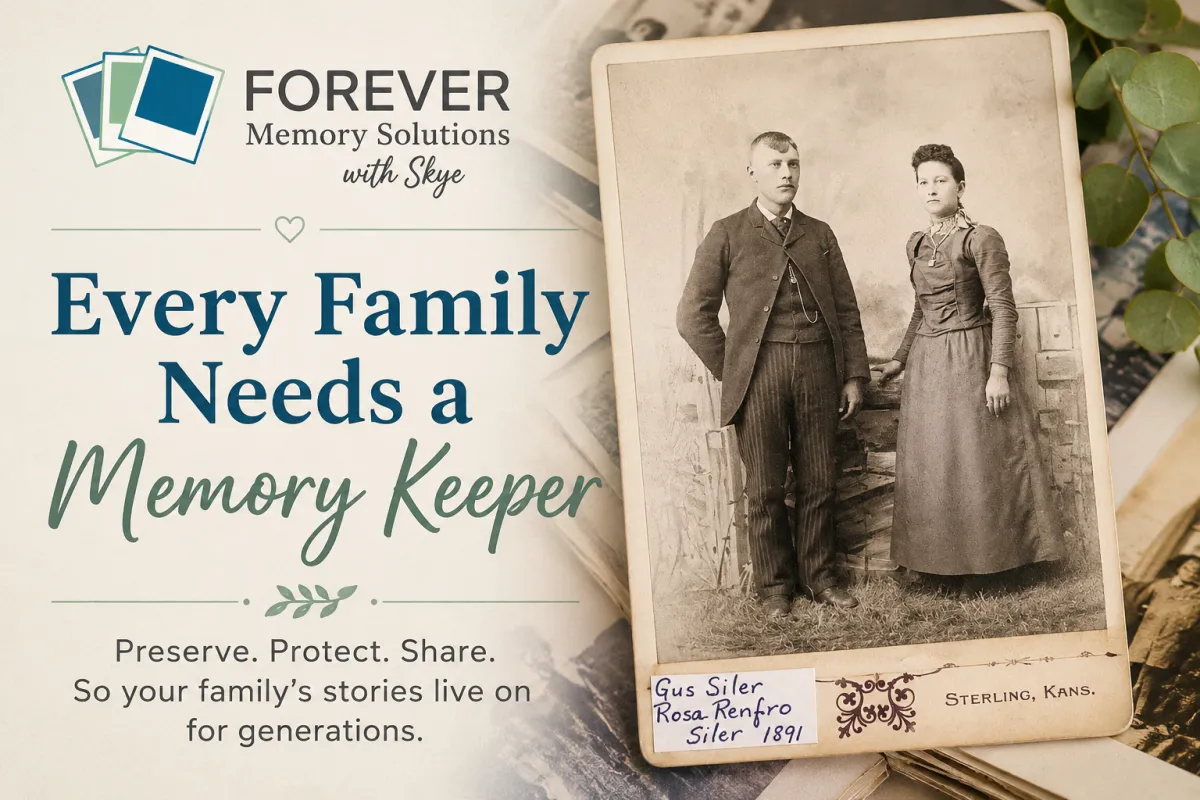
I was working on something completely different on a genealogy website when I happened across a wedding photograph of my great-great-grandparents that I had never seen before.

I was thrilled to find it, of course. But it also got me thinking about family memory keepers and what happens to family photographs as they're passed from one generation to the next.
Who Gets the Family Photos?
Think about what happens when Grandma dies.
Someone gets the photo albums. Someone gets the box of old photographs. Someone ends up with the home movies, letters, documents, scrapbooks, genealogy materials, and other pieces of family history.
Usually, they aren't divided equally among all the children and grandchildren. They tend to go to one person—the person who is interested in family history, the person who volunteers to take them, or simply the person who has room for all the boxes.
In other words, the family memory keeper.
And thank goodness for those memory keepers! Someone kept my great-great-grandparents' wedding photograph all these years. Without that person—and probably several memory keepers along the way—I might never have seen it.
But there's also a weakness in this system.
One Photograph, Many Branches of the Family
When there is only one physical copy of a photograph, only one person can possess it.
Imagine Grandma has four children and one of them inherits the family photographs. Years later, those photographs may pass to one of that child's children, and then perhaps to one of their children.
Meanwhile, there may be entire branches of the family who have no idea those photographs even exist.
That's essentially what happened to me. Somewhere along the way, my great-great-grandparents' wedding photograph traveled down a path that didn't lead directly to me.
Fortunately, someone eventually digitized and shared it.
And that changes everything.
Digitizing Family Photos Makes Them Shareable
Digitizing old family photographs, slides, negatives, home movies, documents, and other memories gives us an opportunity previous generations didn't have.
We don't have to decide who gets the one copy.
Once something is digitized, it can be preserved and shared with siblings, cousins, children, grandchildren, and other family members. A photograph that has lived in one family's box for decades can become part of the heritage of every branch of the family.
But digitizing is only part of the solution.
Those digital files also need a safe, permanent home where they can be organized, identified, preserved, and shared. That's one of the reasons I use FOREVER Storage® for my own family's memories.
I can preserve the digital files, but I can also add the information that makes them meaningful. Who are the people? When and where was the photograph taken? What's the story behind it?
Because a hundred years from now, having the photograph is wonderful.
Knowing who is in it is even better.
Preserving Family Memories Means Thinking Ahead
There's one more piece we sometimes forget.
If you're the family memory keeper, does your family know what you've done with everything?
Do your children or other family members know where your digitized memories are stored? Do they know you have a FOREVER account? Do they know that you've spent years identifying people, organizing photographs, preserving videos, and recording family stories?
Preserving family photos and stories for future generations shouldn't depend on someone someday discovering a password on a sticky note or finding an unfamiliar hard drive in a drawer.
Part of being a family memory keeper is making sure there's a plan for the future.
Don't Just Keep It—Pass It On
Maybe the better question for those of us who have become our family's memory keepers is this:
Who else has access to what I have?
If you have the family photo albums, are there photographs your cousins have never seen? If you've digitized old home movies, have you shared them with your siblings? If you've identified the people in old photographs, is that information recorded somewhere besides in your own head? And does someone else in your family know where all of this is stored and how to access it?
That's something I'm thinking about a little differently after finding that wedding photograph this week.
I'm grateful someone kept it.
I'm even more grateful someone shared it.
Because ultimately, being the family memory keeper isn't about being the person who has all the memories. It's about being the person who helps make sure those memories aren't lost—and that they remain available to the family they belong to.
Every family needs a memory keeper. But the memories shouldn't stop with the memory keeper.