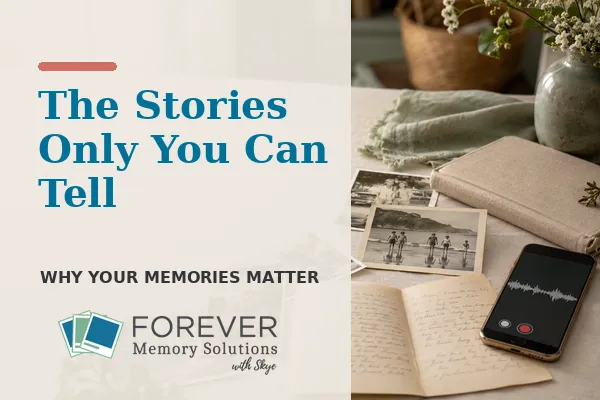
The Stories Only You Can Tell: Why Your Memories Matter
You probably have photos that make perfect sense to you.
You know who is pictured, what was happening, why everyone was laughing, and what happened just before—or just after—the picture was taken.
But will someone else know those things years from now?
A photo can show us what happened. The story behind it tells us why it mattered.
The details we carry in our heads are part of the memory
Names and dates are helpful, but they are only the beginning. The details that bring a memory to life are often the things no official record will ever include:
The nickname everyone used
The recipe that appeared at every family gathering
The phrase Grandpa always said
The reason someone was missing from a photograph
The way a child reacted to a special event
The ordinary tradition your family never thought to document
Around Pioneer Day (July 24 in Utah), we often think about the stories of people who came before us. Some families have pioneer ancestors; others have stories of starting over, moving somewhere new, building a business, raising a family through difficult years, or creating traditions in a new place. Those experiences are worth preserving too.
You do not have to write an entire life history
Family-story preservation can sound like an enormous project. It does not have to be.
Start with one photo and answer five simple questions:
Who is pictured?
When and where was it taken?
What was happening?
What do you personally remember about it?
Why does this photo matter to you?
Even one or two sentences can turn an unidentified image into a meaningful piece of family history.
Choose the method that feels easiest
There is no single correct way to preserve a story. You might:
Add a description to a photo in your FOREVER Storage account.
Record yourself or a relative telling the story aloud.
Scan handwritten letters, journals, recipes, or scrapbook pages.
Create a photo book that includes both pictures and journaling.
Digitize an old home movie, then clip, combine, title, or enhance it with FOREVER Video Editing.
Capture a meaningful frame from a video and preserve it as a photograph.
The best method is the one you will actually use.
What is the easiest way to begin preserving family stories?
Choose one picture you care about—not necessarily the oldest or most important one. Add the details you would want a grandchild, cousin, or future family historian to know. Then stop. You have completed one memory.
You can always do another tomorrow.
Your memories are part of your family’s history
You may not think of yourself as the family historian, but you know things no one else knows in quite the same way. Your perspective, your memories, and your voice are part of the record.
This week, choose one photo and add one story. It does not need to be polished. It simply needs to be preserved.
If you would like help deciding where or how to save your stories, send me a message. I’m always happy to help you find a manageable place to begin.